
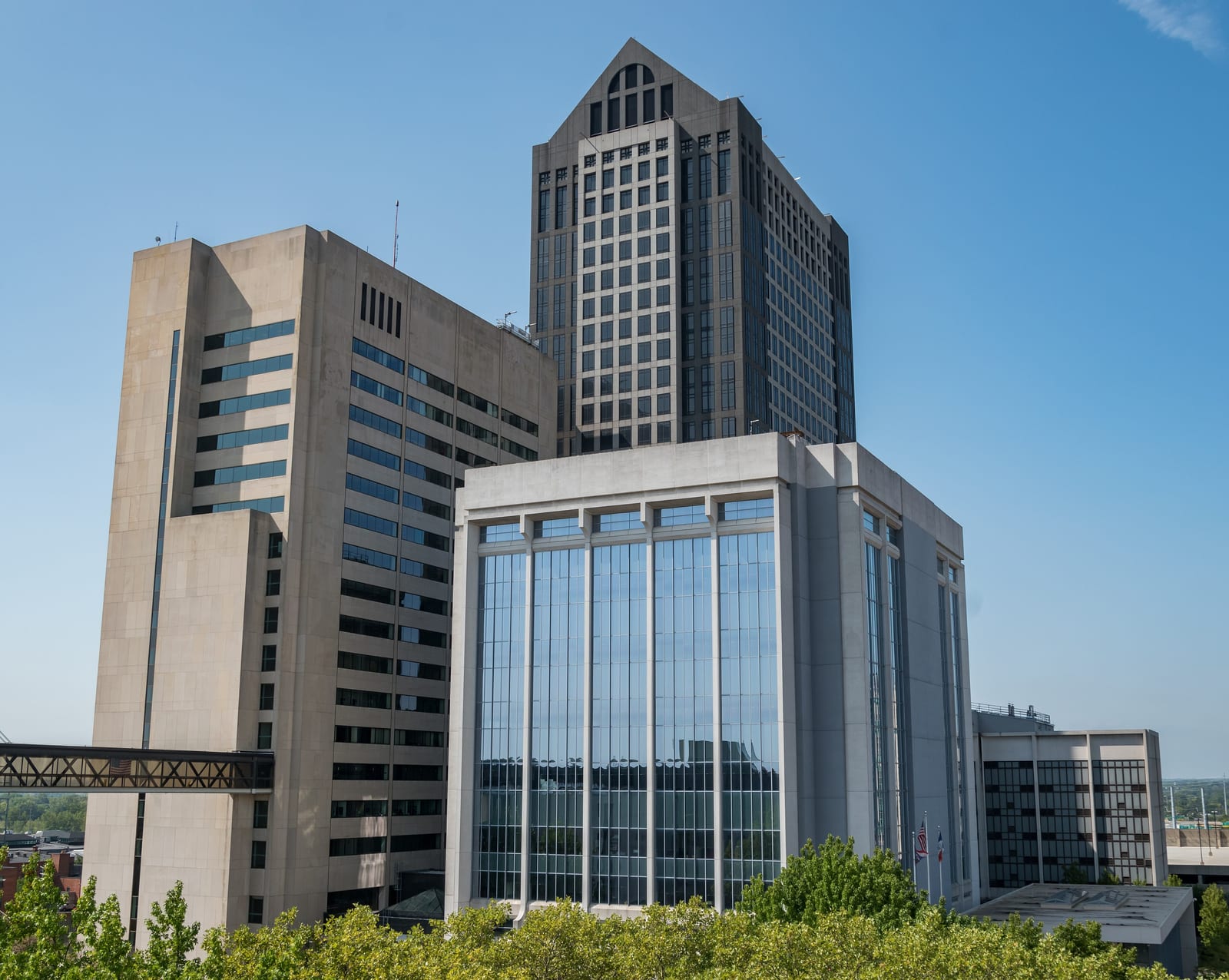
Franklin County, Ohio: Diversifying Metro county. In 2024, voted D+28%. Republican peak: R+33 in 1924.
Key facts
- 2024 presidential margin
- D+28MIT Election Lab
- Political typology
- Diversifying MetroAkashic typology
- Population
- 1,333,0482024 5-year
- Median household income
- $75,1762024 5-year
- White (non-Hispanic)
- 59.0%2024 5-year
- Black
- 23.3%2024 5-year
- Hispanic / Latino
- 7.5%2024 5-year
- Peak Democratic margin
- D+31 in 2020MIT Election Lab
- Peak Republican margin
- R+33 in 1924MIT Election Lab
- Most similar
- Mecklenburg County, NC · similarity 0.99
| Kamala Harris ✓Democratic | 63.0% | 380,518 |
|---|---|---|
| Donald TrumpRepublican | 34.9% | 210,830 |
| OtherAll other candidates | 2.1% | 12,836 |
| Year | Margin (D minus R) |
|---|---|
| 1876 | No data |
| 1880 | No data |
| 1884 | No data |
| 1888 | No data |
| 1892 | +3.7% |
| 1896 | −5.0% |
| 1900 | −5.7% |
| 1904 | −26.8% |
| 1908 | −10.4% |
| 1912 | +15.6% |
| 1916 | +16.7% |
| 1920 | −10.2% |
| 1924 | −33.0% |
| 1928 | −32.2% |
| 1932 | −7.2% |
| 1936 | +17.0% |
| 1940 | +2.2% |
| 1944 | −5.2% |
| 1948 | −7.5% |
| 1952 | −20.5% |
| 1956 | −31.6% |
| 1960 | −18.7% |
| 1964 | +8.1% |
| 1968 | −16.6% |
| 1972 | −29.6% |
| 1976 | −14.1% |
| 1980 | −15.3% |
| 1984 | −30.4% |
| 1988 | −20.9% |
| 1992 | −2.2% |
| 1996 | +3.6% |
| 2000 | +1.0% |
| 2004 | +9.2% |
| 2008 | +20.7% |
| 2012 | +22.7% |
| 2016 | +25.6% |
| 2020 | +31.4% |
| 2024 | +28.1% |
| Year | Won | Margin | Democratic | Republican | Total |
|---|---|---|---|---|---|
| D | 380,518 | 210,830 | 604,184 | ||
| D | 409,144 | 211,237 | 630,577 | ||
| D | 351,198 | 199,331 | 593,435 | ||
| D | 346,373 | 215,997 | 574,610 | ||
| D | 334,709 | 218,486 | 561,763 | ||
| D | 285,801 | 237,253 | 525,827 | ||
| D | 202,018 | 197,862 | 414,074 | ||
| D | 192,795 | 178,412 | 400,515 | ||
| R | 176,656 | 186,324 | 444,801 | ||
| R | 147,585 | 226,265 | 377,357 | ||
| R | 131,530 | 250,360 | 390,474 | ||
| R | 143,932 | 200,948 | 373,045 | ||
| R | 141,624 | 189,645 | 340,712 | ||
| R | 117,562 | 219,771 | 344,808 | ||
| R | 101,240 | 148,933 | 287,624 | ||
| D | 154,527 | 131,345 | 285,872 | ||
| R | 110,283 | 161,178 | 271,461 | ||
| R | 78,852 | 151,544 | 230,396 | ||
| R | 91,620 | 138,894 | 230,514 | ||
| R | 84,806 | 98,707 | 184,999 | ||
| R | 89,394 | 99,292 | 188,686 | ||
| D | 96,601 | 92,533 | 189,134 | ||
| D | 90,746 | 63,830 | 158,047 | ||
| R | 58,539 | 67,957 | 130,160 | ||
| R | 47,084 | 92,019 | 139,712 | ||
| R | 26,505 | 61,891 | 107,295 | ||
| R | 48,452 | 59,691 | 110,064 | ||
| D | 34,103 | 24,107 | 59,727 | ||
| D | 20,697 | 12,791 | 50,715 | ||
| R | 23,314 | 28,914 | 54,097 | ||
| R | 15,502 | 27,439 | 44,622 | ||
| R | 19,809 | 22,237 | 42,636 | ||
| R | 18,320 | 20,291 | 39,053 | ||
| D | 15,495 | 14,341 | 30,835 | ||
| — | — | — | — | ||
| — | — | — | — | ||
| — | — | — | — | ||
| — | — | — | — |
Demographics
Franklin County anchors Ohio's capital and largest city, producing Democratic presidential margins above 25 points in each of the last three cycles. Its rapid population growth, driven by a major research university and healthcare sector, has steadily widened that gap.
The Democratic margin here reached thirty-one points in 2020. Between 2020 and 2024 the county moved three points toward the Republican candidate; the 2024 margin was twenty-eight points.
A population of 1,333,048, a 59% non-Hispanic-white share, and a median household income of $75,176 describe the county. The county's voting pattern over the last decade is most similar to that of Mecklenburg County and Montgomery County.
Compare two places, side by side
Twelve curated comparisons line up election history, demographics, and the divergence story for two places at a glance. Browse all comparisons →
Franklin County, Ohio. Akashic. https://akashic.app/county/39049/. Accessed May 20, 2026. License: CC BY 4.0.