
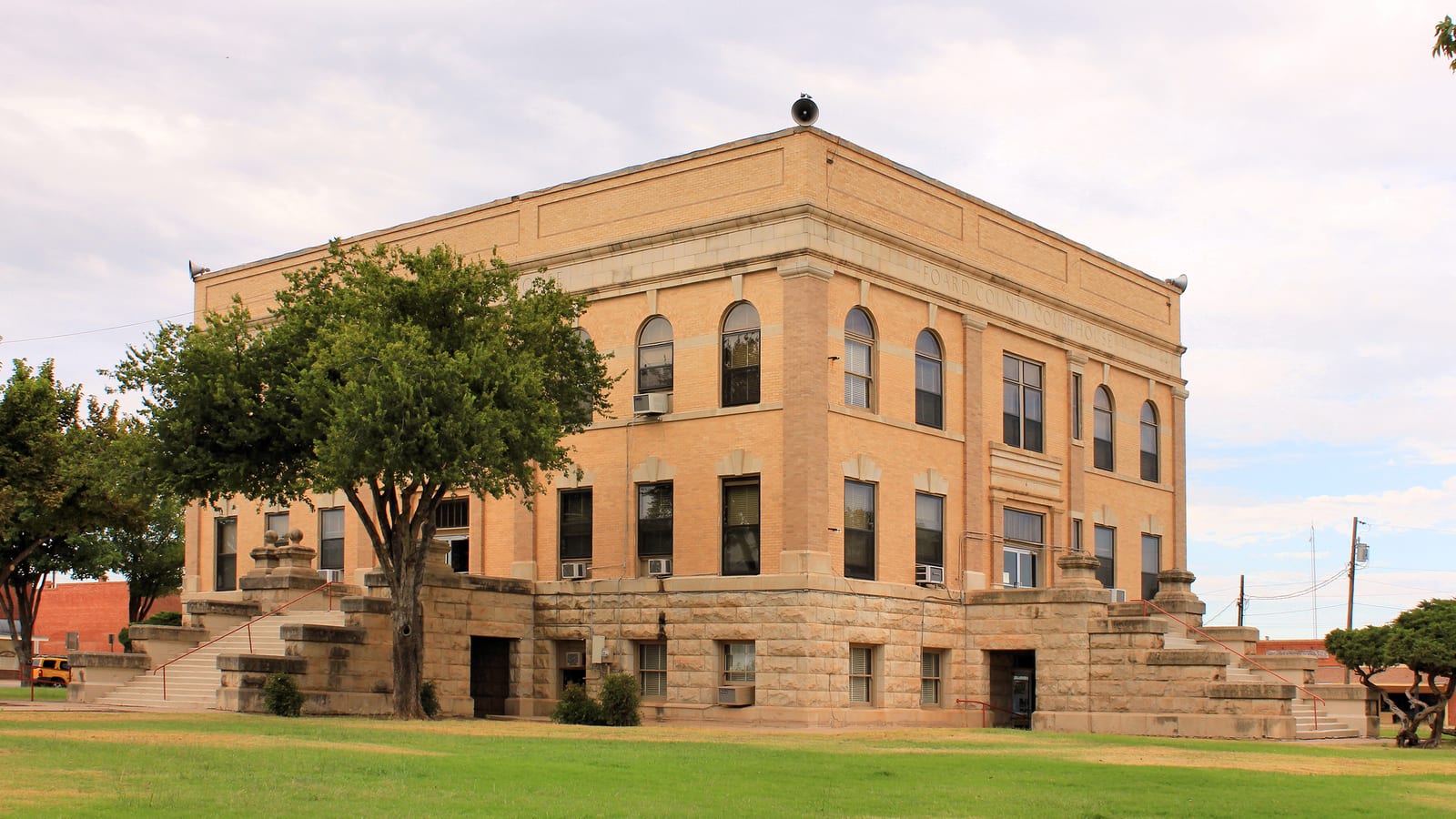
Foard County, Texas: Appalachian Realigners county. In 2024, voted R+65%. Democratic peak: D+87 in 1932.
Key facts
- 2024 presidential margin
- R+65MIT Election Lab
- Political typology
- Appalachian RealignersAkashic typology
- Population
- 9912024 5-year
- Median household income
- $61,5632024 5-year
- White (non-Hispanic)
- 83.7%2024 5-year
- Black
- 0.3%2024 5-year
- Hispanic / Latino
- 11.9%2024 5-year
- Peak Democratic margin
- D+87 in 1932MIT Election Lab
- Peak Republican margin
- R+65 in 2024MIT Election Lab
- Most similar
- Ballard County, KY · similarity 1.00
| Donald Trump ✓Republican | 82.2% | 448 |
|---|---|---|
| Kamala HarrisDemocratic | 16.9% | 92 |
| OtherAll other candidates | 0.9% | 5 |
| Year | Margin (D minus R) |
|---|---|
| 1876 | No data |
| 1880 | No data |
| 1884 | No data |
| 1888 | No data |
| 1892 | No data |
| 1896 | No data |
| 1900 | No data |
| 1904 | No data |
| 1908 | No data |
| 1912 | +66.9% |
| 1916 | +71.9% |
| 1920 | +62.0% |
| 1924 | +68.5% |
| 1928 | +4.0% |
| 1932 | +87.4% |
| 1936 | +85.0% |
| 1940 | +75.1% |
| 1944 | +77.9% |
| 1948 | +75.5% |
| 1952 | +32.8% |
| 1956 | +47.6% |
| 1960 | +45.5% |
| 1964 | +70.1% |
| 1968 | +38.7% |
| 1972 | −8.3% |
| 1976 | +49.1% |
| 1980 | +27.4% |
| 1984 | −2.6% |
| 1988 | +25.2% |
| 1992 | +28.6% |
| 1996 | +33.0% |
| 2000 | −4.1% |
| 2004 | −19.1% |
| 2008 | −24.0% |
| 2012 | −42.0% |
| 2016 | −52.6% |
| 2020 | −62.8% |
| 2024 | −65.3% |
| Year | Won | Margin | Democratic | Republican | Total |
|---|---|---|---|---|---|
| R | 92 | 448 | 545 | ||
| R | 99 | 445 | 551 | ||
| R | 113 | 383 | 513 | ||
| R | 140 | 348 | 495 | ||
| R | 198 | 327 | 538 | ||
| R | 235 | 347 | 587 | ||
| R | 263 | 286 | 556 | ||
| D | 355 | 166 | 573 | ||
| D | 435 | 207 | 796 | ||
| D | 513 | 306 | 820 | ||
| R | 448 | 472 | 925 | ||
| D | 617 | 349 | 978 | ||
| D | 706 | 240 | 950 | ||
| R | 312 | 369 | 685 | ||
| D | 594 | 216 | 978 | ||
| D | 833 | 146 | 980 | ||
| D | 723 | 270 | 995 | ||
| D | 687 | 243 | 932 | ||
| D | 830 | 418 | 1,256 | ||
| D | 751 | 90 | 876 | ||
| D | 925 | 84 | 1,080 | ||
| D | 997 | 142 | 1,139 | ||
| D | 928 | 74 | 1,005 | ||
| D | 882 | 53 | 948 | ||
| D | 466 | 430 | 905 | ||
| D | 585 | 95 | 715 | ||
| D | 491 | 101 | 629 | ||
| D | 475 | 41 | 604 | ||
| D | 429 | 18 | 614 | ||
| — | — | — | — | ||
| — | — | — | — | ||
| — | — | — | — | ||
| — | — | — | — | ||
| — | — | — | — | ||
| — | — | — | — | ||
| — | — | — | — | ||
| — | — | — | — | ||
| — | — | — | — |
Demographics
Foard County's roughly 1,600 residents make it among the smallest in Texas by population, and its presidential margins have grown steadily more lopsided over two decades as rural depopulation has concentrated a predominantly older, agricultural electorate.
The unraveling was not abrupt. The Democratic margin peaked at eighty-seven points in 1932 and narrowed across the late twentieth century. The 2000 election carried the county to the Republican party for the first time in many years, by four points. Between 2020 and 2024 the county moved three points toward the Republican candidate; the 2024 margin was sixty-five points.
The economic context is severe: a median household income of $61,563 — among the lowest at this geographic scale — and a 6% poverty rate. The county's voting pattern over the last decade is most similar to that of Ballard County and Fisher County.
Compare two places, side by side
Twelve curated comparisons line up election history, demographics, and the divergence story for two places at a glance. Browse all comparisons →
Foard County, Texas. Akashic. https://akashic.app/county/48155/. Accessed May 20, 2026. License: CC BY 4.0.