
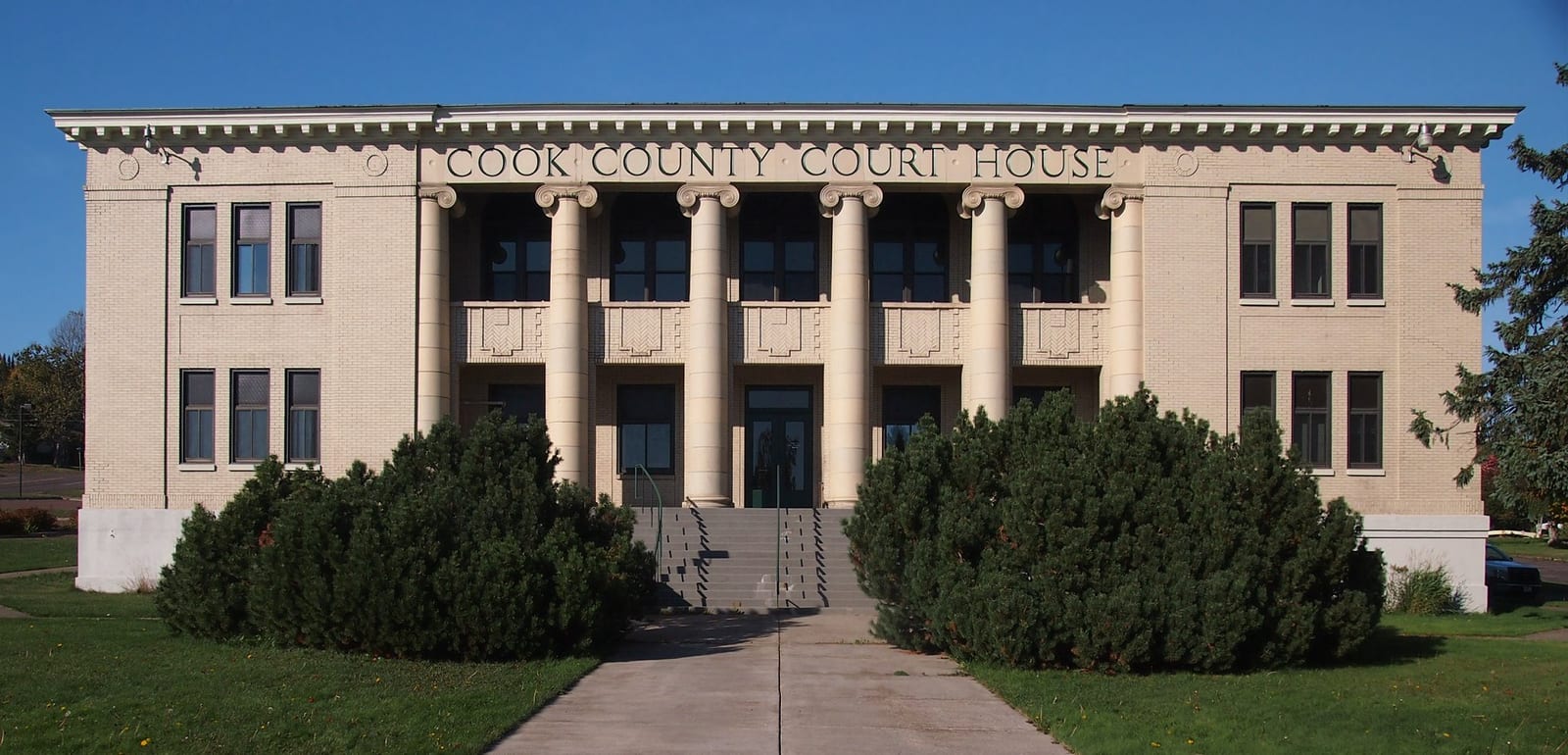
Cook County, Minnesota: Realigning Affluent Suburb county. In 2024, voted D+35%. Republican peak: R+70 in 1904.
Key facts
- 2024 presidential margin
- D+35MIT Election Lab
- Political typology
- Realigning Affluent SuburbAkashic typology
- Population
- 5,6352024 5-year
- Median household income
- $72,6382024 5-year
- White (non-Hispanic)
- 84.2%2024 5-year
- Black
- 1.3%2024 5-year
- Hispanic / Latino
- 3.1%2024 5-year
- Peak Democratic margin
- D+37 in 1892MIT Election Lab
- Peak Republican margin
- R+70 in 1904MIT Election Lab
- Most similar
- Juneau City and Borough, AK · similarity 0.99
| Kamala Harris ✓Democratic | 66.0% | 2,416 |
|---|---|---|
| Donald TrumpRepublican | 31.2% | 1,142 |
| OtherAll other candidates | 2.8% | 102 |
| Year | Margin (D minus R) |
|---|---|
| 1876 | No data |
| 1880 | No data |
| 1884 | No data |
| 1888 | No data |
| 1892 | +37.1% |
| 1896 | +13.5% |
| 1900 | −10.4% |
| 1904 | −70.4% |
| 1908 | −65.1% |
| 1912 | +10.1% |
| 1916 | +10.2% |
| 1920 | −57.6% |
| 1924 | −63.8% |
| 1928 | −46.5% |
| 1932 | +7.7% |
| 1936 | +33.7% |
| 1940 | +1.0% |
| 1944 | +3.0% |
| 1948 | +1.0% |
| 1952 | −30.5% |
| 1956 | −23.5% |
| 1960 | −20.5% |
| 1964 | +12.2% |
| 1968 | −4.4% |
| 1972 | −16.8% |
| 1976 | −0.8% |
| 1980 | −12.2% |
| 1984 | −3.8% |
| 1988 | +0.1% |
| 1992 | +4.9% |
| 1996 | +6.3% |
| 2000 | −4.4% |
| 2004 | +7.4% |
| 2008 | +23.3% |
| 2012 | +23.2% |
| 2016 | +22.3% |
| 2020 | +34.0% |
| 2024 | +34.8% |
| Year | Won | Margin | Democratic | Republican | Total |
|---|---|---|---|---|---|
| D | 2,416 | 1,142 | 3,660 | ||
| D | 2,496 | 1,203 | 3,806 | ||
| D | 1,912 | 1,156 | 3,395 | ||
| D | 1,993 | 1,221 | 3,322 | ||
| D | 2,019 | 1,240 | 3,348 | ||
| D | 1,733 | 1,489 | 3,303 | ||
| R | 1,171 | 1,295 | 2,820 | ||
| D | 1,169 | 1,010 | 2,529 | ||
| D | 1,005 | 878 | 2,618 | ||
| D | 1,080 | 1,078 | 2,184 | ||
| R | 1,129 | 1,219 | 2,361 | ||
| R | 871 | 1,147 | 2,266 | ||
| R | 1,018 | 1,034 | 2,130 | ||
| R | 742 | 1,047 | 1,817 | ||
| R | 777 | 853 | 1,729 | ||
| D | 976 | 764 | 1,742 | ||
| R | 650 | 987 | 1,641 | ||
| R | 668 | 1,078 | 1,748 | ||
| R | 503 | 946 | 1,454 | ||
| D | 688 | 674 | 1,406 | ||
| D | 545 | 513 | 1,066 | ||
| D | 686 | 673 | 1,366 | ||
| D | 793 | 387 | 1,204 | ||
| D | 492 | 418 | 966 | ||
| R | 219 | 609 | 839 | ||
| R | 29 | 471 | 693 | ||
| R | 98 | 467 | 641 | ||
| D | 162 | 125 | 363 | ||
| O | 65 | 30 | 348 | ||
| R | 42 | 255 | 327 | ||
| R | 31 | 207 | 250 | ||
| R | 65 | 81 | 154 | ||
| D | 107 | 81 | 192 | ||
| D | 68 | 19 | 132 | ||
| — | — | — | — | ||
| — | — | — | — | ||
| — | — | — | — | ||
| — | — | — | — |
Demographics
Cook County's vast wilderness and small, dispersed population have long produced lopsided Democratic margins — its 2024 result of D+34.8 makes it one of Minnesota's most reliably left-leaning rural counties, an unusual pattern in nonurban America.
Once reliably Republican — a margin of seventy points in 1904 at its widest — Cook County has trended Democratic. Between 2020 and 2024 the county moved one point toward the Democratic candidate; the 2024 margin was thirty-five points.
A median household income of $72,638 — among the higher at this geographic scale — and a population of 5,635 describe the county. The county's voting pattern over the last decade is most similar to that of Juneau City and Borough and Whatcom County.
Compare two places, side by side
Twelve curated comparisons line up election history, demographics, and the divergence story for two places at a glance. Browse all comparisons →
Cook County, Minnesota. Akashic. https://akashic.app/county/27031/. Accessed May 20, 2026. License: CC BY 4.0.